Had a great time at the Abraham Inc. concert a couple of weeks ago. Fabulous sound from an unlikely blend of klezmer music, funk, jazz, rap, and hiphop.
Here's a video of the studio version of "Tweet tweet."
http://www.youtube.com/watch?v=Rc29Fwz20fQ
Fred Wesley is on the trombone; earlier in his career he was with James Brown and also with George Clinton and Parliament-Funkadelic.
Tuesday, February 15, 2011
Monday, December 20, 2010
Moravian Candle Tea
The Moravian Christmas Candle Tea for 2010 concluded last weekend. A tradition in Salem, North Carolina since 1929, Candle Tea is sponsored by the Women's Fellowship of Home Moravian Church. For two weekends following Thanksgiving every year, the women of the church transform the historic Single Brothers' House into a seasonal, sensory delight. Visitors move through different rooms of the Brothers' House and experience much-loved and uniquely Moravian Christmas traditions.
When you enter the building, you are first ushered into the Ante Room, where a hostess will tell you a bit of history about the single brothers and this house where they lived in while learning their trades.
After singing carols, you are escorted downstairs to watch a demonstration of beeswax candles being made, in what was the dining room for the single brothers. Moravians have used candles in Christmas Eve services dating back to 1747 - a time when Christmas Eve services were almost unheard of. These handmade candles, with their distinctive red crepe paper ruffs, are used at Christmas Eve services throughout the Moravian Church, and they are often seen in non-Moravian congregations as well.
When you have finished your cake and coffee, you proceed downstairs once again, this time to the sub-basement of the building.
This is where the single brothers stored their food; it is cold and dark, the walls are over a foot thick, and the floors are large slabs of stone.
The second room in the sub-basement, and the last room you will visit in Candle Tea, features the Nativity Scene. Different scenes of the birth narrative from Luke are displayed in a cave-like setting (again, a food-storage area for the brothers), and the overall effect of a grotto on a cold winter night is very effective. The wooden figures in this scene were made in Oberammergau, Germany, over fifty years ago.
Monday, December 13, 2010
Book Stew
I think I am just a sucker for stacks of books. After completing my research on Virginia Woolf and To the Lighthouse, I wanted to take a picture of some of the friends who have accompanied me for the last two months, before I return them back to their homes (the libraries of the University of Tennessee, University of Miami, and Wake Forest University). What a miracle inter-library loan is. In this photo, leaning happily on the scholarly works is, of course, Julia Child's Mastering the Art of French Cooking. I prepared Boeuf en Daube for the class, and I relied on Julia's recipe as a starting point for my 21st century crock-pot version of the dish.
Labels:
Boeuf en Daube,
books,
Julia Child,
libraries,
Virginia Woolf
Tuesday, December 7, 2010
Who's Afraid....
This semester I was enrolled in a class which discussed the nature of happiness, joy, sorrow, and melancholy, and how these states relate to ethics, aesthetics, and knowledge.From August to December, we worked our way through various works of philosophers, poets, novelists, and filmmakers. My personal focus for the class was on Virginia Woolf, and specifically her novel, To the Lighthouse. Having never read Woolf previously, I will say that To the Lighthouse was not an easy read the first time through. However, after plowing through a fair amount of supplementary readings, both in books and journal articles, and frequently revisiting the text, I found To the Lighthouse offers a rich and satisfying literary experience. Woolf was born in London, in 1882, to a well-to-do, educated family. Her mother died when she was thirteen, her father died when she was twenty-two. To the Lighthouse was published when she was forty-five; it was her fifth novel; she completed nine. She was very clear that To the Lighthouse was where she laid to rest the ghosts of her parents. The work is complex; in it, one can find meaningful and interesting parallels to any number of themes: feminist theory, aesthetics, societal issues, gender roles, theology. The two papers and class presentation that I prepared on the novel looked at the symmetrical structure of the novel, the ways in which Woolf placed dichotomies together, and in particular the sacramental symbolism of the important dinner scene at the centerpoint of the book. In the dinner scene, the primary figure of the novel, Mrs. Ramsay reaches a moment of transcendence as she serves Boeuf en Daube (a rustic French beef stew) to her dinner guests. "Just now she had reached security; she hovered like a hawk suspended; like a flag floated in an element of joy which filled every nerve of her body fully and sweetly...Nothing need be said; nothing could be said. There it was, all around them. It partook, she felt, carefully helping Mr. Bankes to a specially tender piece, of eternity" (To the Lighthouse, 104-5; Harvest/Harcourt edition).
Here, Woolf is drawing out a beautiful polarity between the everyday act of serving beef stew and an ethereal, meaningful moment. If you read the sentence carefully, you will see what else Mrs. Ramsay is serving. When I realized that this passage sits at dead center in the book (page 105 out of 209), I had my own little moment of transcendence.
For me, the most lovely passage in the book follows on page 106, as we are drawn from the dinnertime chatter and clangor into Mrs. Ramsay's inner thoughts: "...her eyes were so clear that they seemed to go round the table unveiling each of these people, and their thoughts and their feelings, without effort like a light stealing under water so that its ripples and the reeds in it and the minnows balancing themselves, and the sudden silent trout are all lit up hanging, trembling. So she saw them; she heard them; but whatever they said had also this quality, as if what they said was like the movement of a trout when, at the same time, one can see the ripple and the gravel, something to the right, something to the left; and the whole is held together...For the moment, she hung suspended." I think Woolf does a marvelous job of immersing the room into eternity.
I like this quote about the dinner scene, from Mitchell Leaska in Virginia Woolf's Lighthouse: A Study in Critical Method: "Like a kaleidoscope being slowly rotated, each piece - each thought, each reverie - slips into its appropriate place to design a poised pattern of stresses and strains, an exquisite balance of human relationships" (107).
Saturday, October 2, 2010
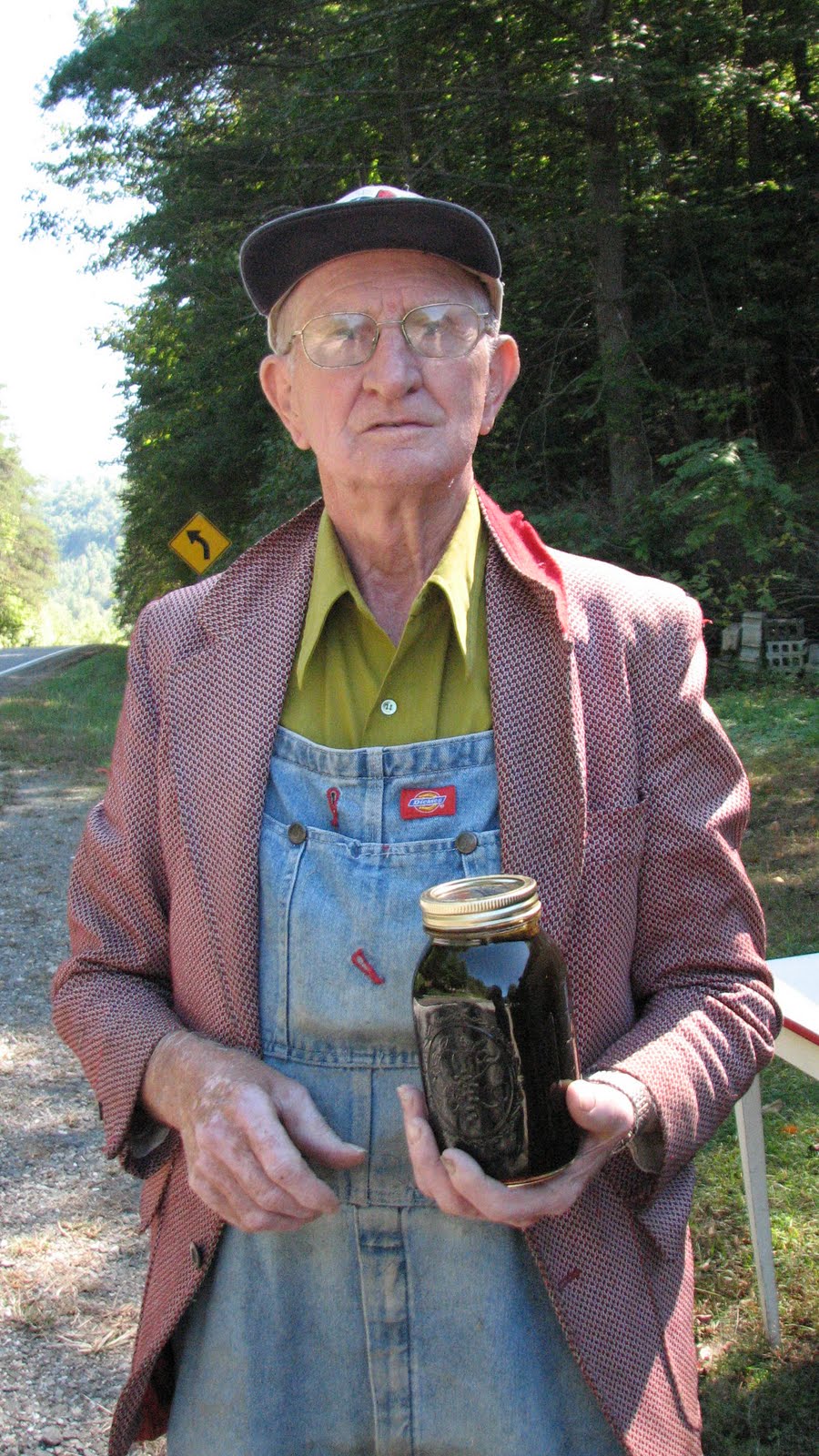
Mo' about Molasses and Local Food
The 10% Farm to Fork campaign is an initiative sponsored by the Center for Environmental Farming Systems, the North Carolina Cooperative Extension, and the Golden Leaf Foundation. The campaign encourages participants to pledge to spend 10% of their weekly food purchases on local foods. We now have a local foods and sustainable agriculture advocate in our household, so I've joined the 10% campaign.
Today was a beautiful, sunny fall day in North Carolina, and we made several stops on our way to the mountains. I realized later that every place we visited had resulted in a purchase of local foods. First was the Shiloh General Store, an Amish store in Yadkin County. Not surprisingly they do not have a website, but their address is 5520 St. Paul Church Road, Hamptonville, NC, located off the Windsor Road exit of Highway 421, which is not far from the intersection of Interstate 77 and Highway 421. The Store carries many hard-to-find, old-fashioned type items, bulk grains, deli cheeses and meats, and even Amish hats. At the General Store, we purchased a loaf of sourdough bread (still warm in the bag), a jar of peach jam, a bag of gingerbread mix from the Old Mill of Guilford (near Greensoboro, NC) and a bag of stone ground corn meal mix from the Linney Water Mill of Union Grove, NC.
Next, we were pleased to find our favorite independent coffee/hot beverage shop open - Java Hills Coffee and Ice Cream, in Millers Creek. Judy does not typically open the shop on Saturdays, but due to the Brushy Mountain Apple Festival, she made an exception and was busy brewing up delicious drinks for her customers.
Just up the road from Java Hills, we enjoyed hot dogs at the Igloo Ice Cream & Sandwich Shop, recently written up in Our State Magazine. 
After lunch, we headed to the Brushy Mountains in search of local apples. By a bit of serendipity we ended up at Tevepaugh Orchards (800 Vannoy Road, Moravian Falls), where we bought a bushel of wonderful Jonagold apples.
I think we contributed much more than 10% of our weekly food dollars to local food purchases for the upcoming week. I did not realize that this would be today's theme, or I would have taken more photos of our stops. I will plan to feature Judy's Java Hills in a future post. In the meantime, buy local!
Sunday, September 12, 2010
Get Low, the movie
A few weeks ago at my annual Marjorie Kinnan Rawlings Birthday/Girls' weekend event, a friend brought along the DVD of a short film directed by Aaron Schneider, based on Faulkner's story Two Soldiers. It is a beautiful film, and a number of the scenes in it were shot locally. Turns out that Schneider's latest film is showing at our local independent theatre. Get Low, starring Robert Duvall, Sissy Spacek, Lucas Black and Bill Murray, is a story of an old codger in the 1930s who comes out of his hermit-like existence in order to plan his pre-death funeral party. Terrific movie!Here is a synopsis and review from MSNBC:
http://today.msnbc.msn.com/id/38431937/ns/today-entertainment/
Labels:
Aaron Schneider,
Get Low,
Robert Duvall,
Two Soldiers,
William Faulkner
Friday, September 10, 2010
Back to Widor, slowly
As posted previously, I am a fan of big, booming pipe organ pieces, and particularly of the Widor Toccata. Charles-Marie Widor was the organist at St. Sulpice in Paris from 1870 to 1933. My favorite recording of Widor's Toccata is on "The Sounds of York Minster," a CD recorded in York, England. What is notable to me about that recording is the pace of the piece is much slower and deliberate than what is typically heard in performances of this work. I have gone so far as timing the piece by a metronome, and suggesting to Ray (otherwise known here as Organist Extraordinaire), as I handed him the number on a scrap of paper, that he try the Toccata more slowly. But when you are an Organist Extraordinaire, your artistic interpretation (including the meter at which you play pieces) does not necessarily yield to outside influences. Today, almost exactly one year after my first post about Widor's marvelous Toccata, my husband has sent me the following (from Wikipedia), specifically addressing the meter of the piece:
“Widor was pleased with the worldwide renown this single piece afforded him, but he was unhappy with how fast many other organists played it. Widor himself always played the Toccata rather deliberately. Many organists play it at a very fast tempo whereas Widor preferred a more controlled articulation to be involved. He recorded the piece, at St. Sulpice in his eighty-ninth year: the tempo used for the Toccata is quite slow.”
And here's Widor at the keyboard:
http://www.youtube.com/watch?v=J8vz1D_L_OE&p=11AADBF440782809&playnext=1&index=27
Labels:
Charles-Marie Widor,
music,
organ music,
St. Sulpice,
toccata,
York Minster
Subscribe to:
Posts (Atom)